


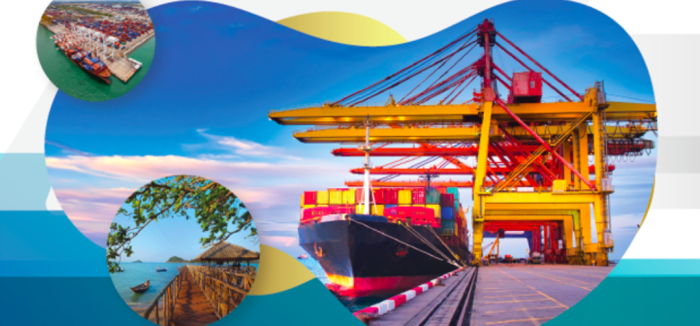
A graphic image depicts the concept of the proposed Land Bridge, a logistics initiative aimed at connecting the Gulf of Thailand with the Andaman Sea.
The Land Bridge project in Thailand has re-emerged as a focal point in policy discussions, yet the issue of financing remains unaddressed. While the geopolitical situation in Thailand has evolved, the core challenge persists: how can the nation transform its infrastructure goals into actionable steps that attract long-term investment?
Envisioned as a strategic corridor, the project seeks to link the Gulf of Thailand with the Andaman Sea, thereby decreasing dependence on the Strait of Malacca and establishing Thailand as a logistics hub in the region.
With concerns surrounding supply-chain resilience, China’s influence in the region, and the rivalry between the U.S. and China, the geopolitical significance of the project is evident. However, the mere appeal of geopolitics does not ensure that the project is financially viable.
For Thailand, creating a credible narrative of growth is essential for national interests. The country faces a persistent dilemma: investors are unlikely to allocate their capital without confidence in growth, yet achieving robust growth is challenging without requisite infrastructure investments.
Ambition alone does not equate to bankability. While governments may emphasize economic internal rates of return, which encompass broader benefits such as efficiency in logistics, tourism, regional development, job creation, and industrial spillovers, private investors conduct a more stringent evaluation of cash flow and return on investment at the project level. Their focus lies not on national aspirations but on projects that have been adjusted for risk.
This presents a significant hurdle for the Land Bridge initiative. Financing a project of this magnitude cannot be achieved solely through slogans, public-private partnership designations, or vague allusions to foreign investor interest. A fundamental question must be clearly addressed: who is responsible for which risks?
Private contractors and lenders are unable to shoulder risks that lie outside their control, such as demand uncertainty, land acquisition issues, environmental opposition, and changes in government policy.
Demand risk is particularly critical. The success of the corridor hinges on whether cargo owners, shipping companies, and logistics providers utilize it at anticipated volumes and prices; otherwise, projected cash flow may not materialize. Therefore, feasibility studies, which often present overly optimistic scenarios, need independent and thorough scrutiny. Without credible support mechanisms, equity sponsors and banks will be reluctant to engage.
However, this does not imply that the Land Bridge should be dismissed. Instead, Thailand needs to reconfigure its financial architecture prior to expecting investment inflows.
For example, establishing a publicly listed infrastructure fund or trust could be part of the solution, linking long-term domestic savings with operational infrastructure assets. Nevertheless, this should not be seen as a definitive solution for absorbing the demand risk associated with a greenfield project of this magnitude, where the demand profile remains uncertain. Typically, investors in such schemes prefer stable cash flows or dividends from existing assets rather than taking the initial risk on a trillion-baht project.
The more feasible role for a listed infrastructure platform would be in capital recycling. After assets are constructed and begin generating predictable cash flows, they can be partially moved into this type of vehicle, providing strategic sponsors, EPC contractors, and O&M partners with a clear exit or refinancing pathway while offering Thai investors, pension funds, insurers, and retail investors stable long-term cash flows without assuming the full risk of early-stage projects. Enhanced exit visibility could also motivate EPC and O&M firms to become minority equity investors or long-term operating partners, facilitating the recycling of capital from completed assets back into new infrastructure initiatives.
However, the listed vehicle represents just one aspect of the solution. Thailand also needs to develop stronger project-level structuring capabilities. Dedicated project companies can serve as intermediaries between strategic sponsors, banks, and capital markets by offering catalytic capital, preferred equity, subordinated debt, refinancing visibility, or structured participation for EPC and O&M partners. When utilized effectively, these companies can enhance transparency in risk allocation rather than obscuring it.
This model is applicable beyond the Land Bridge. Thailand has numerous smaller infrastructure projects that should be easier to finance than a large corridor. Areas such as Phuket, Chiang Mai, Pattaya, and various resort islands are grappling with persistent shortages in public transport, waste management, water systems, and environmental infrastructure.
Combining tourism taxes, user fees, availability payments, municipal support, green financing, and private sector engagement could lead to investable projects. Improved infrastructure is essential for enhancing the quality of tourism, which, in turn, attracts more investment and generates employment opportunities.
Nevertheless, not every essential infrastructure project can or should be entirely commercial. It may not be feasible to bundle unprofitable projects with profitable ones and expect private capital to accept the compromise. When a project is economically vital but financially weak, the government should intervene through public funding, viability gap support, or targeted mechanisms, including Official Development Assistance (ODA) finance where appropriate.
Thailand’s discussions must become more structured in this regard. The nation should distinguish between broad economic benefits and project-level financial returns, as well as separate public policy considerations from private investability. Without this level of discipline and thorough examination, every significant project risks being labeled as strategic without accountability.
The Land Bridge could serve as a pivotal moment for Thailand if it prompts a reevaluation of the country’s infrastructure financing strategy. The government needs to establish clear concession terms and support mechanisms, while project sponsors must create cash flows that are attractive to investors, and capital market institutions should develop credible recycling channels.
A pipeline of smaller, bankable projects may hold equal importance to a single mega-project, as it can cultivate the institutional capabilities needed for larger ambitions.
Thailand should aspire to think big. However, the future of the Land Bridge hinges not only on engineering or political factors but also on the country’s ability to devise a model that transforms national ambitions into viable cash flow.
Source: Bangkok Post