


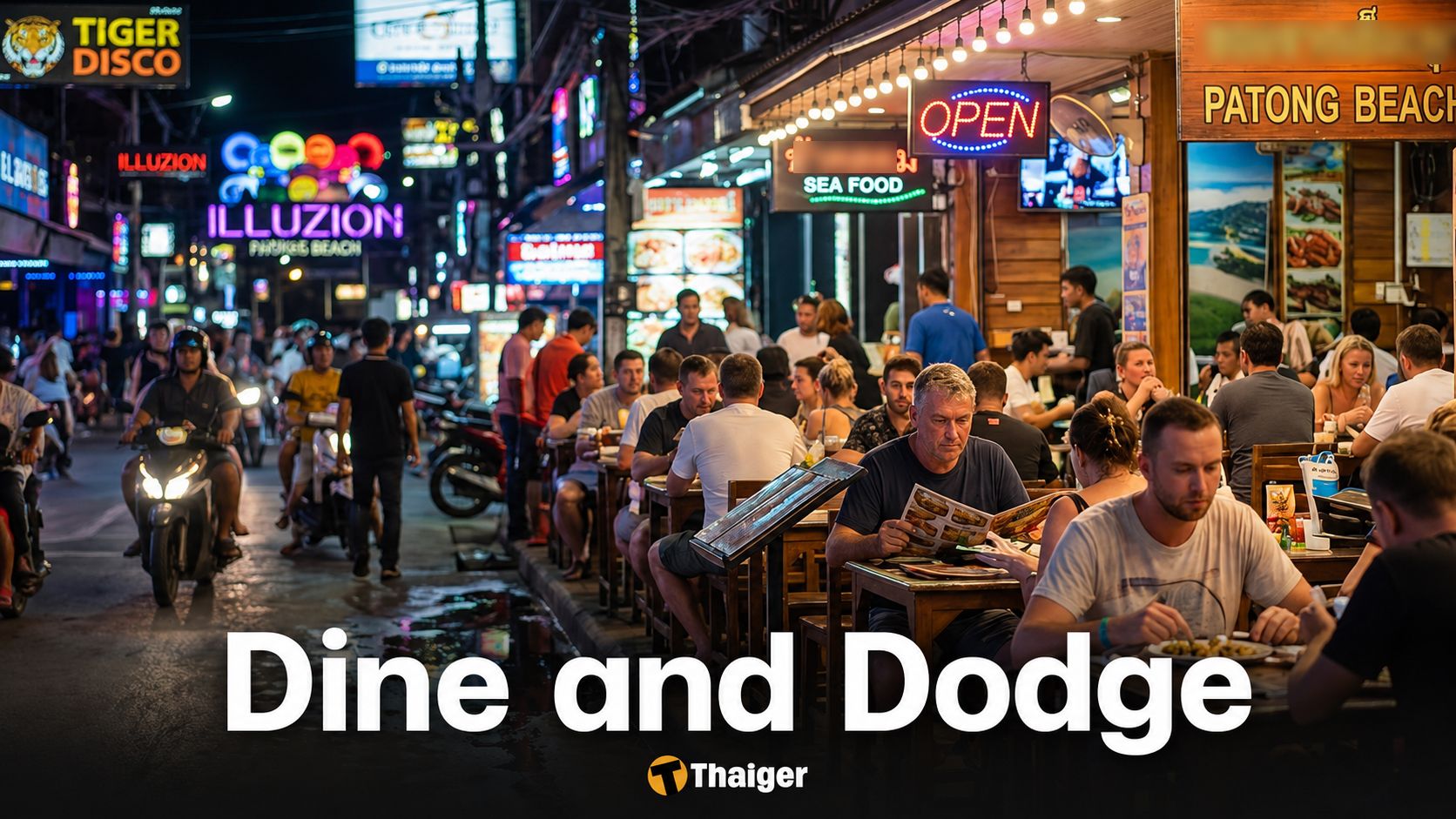
Across Thailand’s popular tourist destinations, small restaurants are increasingly encountering a troubling trend where foreign visitors consume meals and then refuse to settle their bills, leaving owners with limited legal recourse. An incident on April 26, 2024, at a restaurant in Mai Khao, Phuket, highlights this issue when a Russian couple dined and left without paying the 120 baht bill, approximately three dollars. Upon being confronted by the owner, they showed no remorse and suggested she call the police, asserting that law enforcement would not take action against them. Local police arrived to mediate but were unsuccessful, resulting in other customers leaving and the restaurant closing early, leading to a significant loss of business for the owner beyond just the unpaid bill.
The situation has gained traction on Thai social media, eliciting feelings of embarrassment and frustration from restaurant owners throughout the tourist regions. The issue is not about the quality of food, as Thailand is well-known for its exceptional cuisine. For instance, a foreign woman in Phuket refused to pay 80 baht for a strawberry smoothie, claiming it did not meet her expectations, despite the restaurant having nearly two decades of successful service. The restaurant’s owner indicated this was part of a troubling pattern, stating, “There are tourists who come in knowing they will not pay.”
In Ao Nang, Krabi, a parliamentary adviser on police affairs reported a similar case in November 2025, one among 725 incidents logged that year, where a foreign diner enjoyed a meal only to later dispute the food’s quality and refuse payment. These incidents are often characterized as opportunistic behavior, with certain visitors dubbed “snakes of Ao Nang” for exploiting the goodwill of local restaurateurs.
Legally, restaurant bills are seen as civil matters in Thailand. When diners refuse to pay, it is classified as a contractual disagreement, an issue that law enforcement is not equipped to resolve on-site. This legal framework leaves a significant enforcement gap that some tourists seem to exploit, resulting in a repeat cycle: restaurant owners call the police, who attempt mediation, but the tourists often dismiss the matter or walk away, knowing pursuing legal action would be more costly than the original bill itself.
The couple from Russia on that April day was aware of this dynamic, as was another foreign man who was caught on camera leaving a steakhouse in Choeng Talay without paying. In a separate incident in Pattaya in May 2026, a man identified as Moroccan refused to pay a 2,500-baht bar bill, and only after his aggressive behavior did police intervene.
Tourism in Thailand has surged, particularly in Phuket, which welcomed over 14 million visitors in 2025, including over a million from Russia. This influx has changed the nature of arrivals, with Phuket police recording 3,218 cases involving foreign nationals between January 2025 and April 2026, 2,223 of which were identified as tourist-related incidents. Restaurant and hospitality complaints are part of this statistic, which also includes issues like motorbike accidents and drug offenses.
For restaurant owners, the financial implications are severe, as they operate on narrow profit margins in high-rent tourist areas. Even a small unpaid bill can erase profits from multiple tables. Most establishments cannot afford prepayment systems that might deter such behavior, leaving them to absorb losses or close early, as demonstrated by the Mai Khao restaurant owner.
While the issue of tourist behavior is being taken more seriously by Phuket’s provincial police, with increased enforcement updates following public pressure, owners are calling for faster and more accessible resolution methods for low-value disputes. Until such mechanisms are established, small restaurants will continue to face the risk of encountering tourists who calculate the cost of dining and dodging, resulting in unpaid bills and lost revenue.
A mere 120 baht, or three dollars, represents not just the cost of a meal but a significant impact on the livelihoods of those operating these small businesses.
Source: The Thaiger