


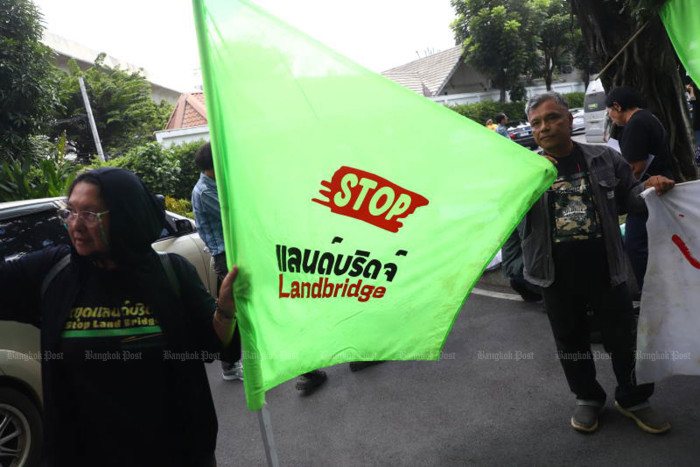
A gathering at the Bhumjaithai Party headquarters on September 18, 2025, saw participants, including a woman waving a green flag inscribed with “Stop the Land Bridge,” unite in protest against the government’s Land Bridge initiative. This coalition, comprising individuals from the South and East, is urging the government to abandon the project.
Opposition is growing from divers and environmental organizations who warn that the Land Bridge megaproject poses significant risks to delicate marine ecosystems and could harm Thailand’s prestigious diving industry. The marine conservation network Digitalay has initiated the “Divers Against Land Bridge” campaign to garner public support against this initiative, which aims to create a transport corridor linking the Gulf of Thailand to the Andaman Sea, accompanied by two deep-sea ports.
To raise awareness, the campaign is utilizing social media platforms to share images and underwater footage, showcasing the rich marine biodiversity of Thailand and engaging those who might never experience these underwater ecosystems directly.
Nat Sumanateme, a professional marine wildlife photographer and a member of Digitalay, noted that the marine environment had shown signs of recovery in recent years due to stricter regulations on illegal, unreported, and unregulated (IUU) fishing. However, he cautioned that the Land Bridge project, endorsed by the Bhumjaithai Party-led government, threatens the sustainability of southern marine ecosystems.
Mr. Nat expressed concerns over the lack of transparency regarding shipping routes, stating, “We still do not know the exact shipping routes because the government has not released detailed information. But regardless of the route, the project will inevitably affect marine ecosystems, especially world-class diving sites such as Richelieu Rock.” He further elaborated that the construction of deep-sea ports would cause significant sedimentation, a major factor contributing to coral reef degradation.
Highlighting the interconnectedness of marine ecosystems, he warned that damage in one area can adversely impact adjacent habitats. He recalled the 2010 coral bleaching crisis in Mu Koh Surin National Park and remarked that its recovery over the past 16 years has relied partly on coral larvae transported by ocean currents from Myanmar. “That natural recovery may no longer occur if there is heavy vessel traffic through sensitive marine routes,” he said, emphasizing potential disruptions to coral migration and marine life reproduction from underwater noise, ship propellers, and oil contamination.
He criticized the government’s approach, stating, “The government has never treated natural resources as national capital. Without transparency, many people will not accept this project.”
The Professional Association of Diving Instructors (Padi) has indicated that Thailand is among the premier global destinations for diving certification, with notable dive sites including Koh Tao, Mu Koh Surin, and Koh Lipe. Napaket Limthanakit, founder of Dive Team Thailand and a master diving instructor, mentioned that Koh Tao alone produces 50,000 divers each year, contributing 10 billion baht to the local economy.
“Thailand is known as the world’s dive school,” Ms. Napaket affirmed, adding that divers typically spend two to three times more than average tourists, incurring expenses related to diving courses, equipment, and boats. Courses in Koh Tao range from 25,000 to 40,000 baht, whereas those in the Andaman Sea can reach up to 100,000 baht.
Ms. Napaket warned, “If we lose Richelieu Rock, divers will stop coming. It is one of the most unique marine habitats in the world, home to rare species such as whale sharks and manta rays.” She stated that divers, marine experts, and public figures would persist in their campaign against the project to safeguard marine resources for future generations.
In response, the ruling Bhumjaithai Party has defended the proposed Land Bridge megaproject, asserting that it remains in the feasibility study phase and will not move forward if studies deem it unviable or if local communities oppose it. In a statement on their Facebook page titled “Clearing Up the Facts About the Land Bridge,” the party clarified that no construction or investment has been approved thus far.
The party emphasized that the project aims to establish Thailand as a logistics hub in the region by cutting maritime transport times, enhancing national competitiveness, creating jobs, and fostering long-term economic growth. They also mentioned that a 90-day impact study committee, led by Deputy Prime Minister and Finance Minister Ekniti Nitithanprapas, will assess the project. The party reiterated that if studies conclude the project is not economically viable or if local residents are against it, the initiative will not proceed.
Source: Bangkok Post