


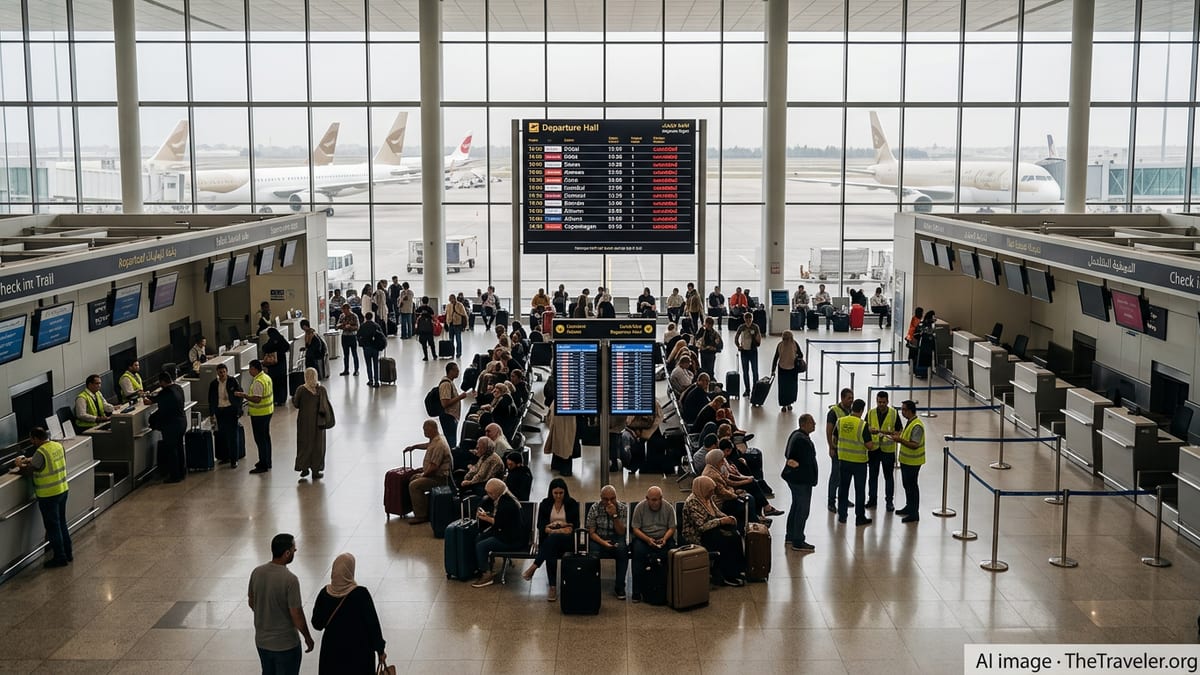
Travelers aiming to fly to and from Thailand are encountering significant disruptions as Gulf Air, Qatar Airways, and other Middle Eastern airlines have canceled and consolidated numerous flights. This affects key routes connecting Bangkok, Phuket, and other Thai hubs to Doha, Tel Aviv, and various international destinations. Recent reports from Thailand and the broader region reveal that Gulf-based airlines have further reduced their services due to airspace restrictions around Iran and Qatar, impacting schedules. Services between Thailand and major hubs like Doha, Dubai, Abu Dhabi, and Bahrain continue to face challenges, with some flights suspended entirely and others operating at much lower frequencies.
Aviation data indicates that Qatar Airways has canceled certain flights from Doha to Bangkok, including some originally scheduled for late May 2026, while still operating others. Additional reports highlight the consolidation or rerouting of flights from Doha to Phuket and Samui on select days, creating uncertainty for travelers with multi-stop itineraries.
Although earlier disruptions at Phuket International Airport have largely subsided, capacity on several routes remains below pre-crisis levels. Analysts suggest that airlines are currently making continuous adjustments rather than imposing blanket suspensions, complicating cancellation predictions for passengers. Gulf Air is among the carriers that have quietly modified their services to Thailand as they manage fluctuating fuel prices and longer flight paths around restricted airspace. In recent days, travel industry briefings indicate that over a dozen flights involving Thailand and Gulf hubs have been removed from schedules, disrupting connections typically used for travel to Europe, North America, and Africa.
The recent disruptions are rooted in the ongoing regional conflict that has led to temporary airspace closures in Qatar and surrounding areas since late February, prompting widespread cancellations and diversions. Even as key air corridors reopen, airlines are compelled to plan with caution due to the potential for renewed tensions, often scheduling with added margins before adjusting frequencies based on demand.
The impact on Thailand has been exacerbated by an oil supply crunch linked to these same regional conflicts. Rising jet fuel prices have already compelled local airlines to reduce domestic and regional services. When combined with longer flight routes and increased insurance and overflight costs, foreign airlines face significant pressures to decrease capacity to Thailand, even on previously lucrative routes.
Data on seat availability for May 2026 shows that the number of airline seats between the Middle East and Thailand has decreased by over one-third compared to levels prior to the Gulf crisis. Bangkok’s Suvarnabhumi Airport, a critical hub in Southeast Asia, has experienced some of the most severe reductions in flights to Doha and other Gulf locations, as airlines prioritize aircraft for routes deemed more stable or strategically important.
One notable aspect of the current disruption phase is the timing of cancellations, which are often announced close to departure dates. Travelers have reported receiving notices for flights scheduled in May and early June just days or weeks prior to travel, even for routes that had appeared to be resuming. This reflects what industry specialists describe as a “rebuilding” phase, where airlines gradually restore their networks while retaining the flexibility to cancel flights as operational risks arise.
Thailand’s heavy dependence on Gulf hubs for long-haul travel means that disturbances on a few key routes can quickly impact multiple markets. The Doha-Bangkok route, one of the busiest connecting Southeast Asia and the Middle East, has been particularly affected by adjustments from Qatar Airways, leading to outright cancellations of certain flights on specific days while others operate with minor changes.
Bangkok’s role as a connecting point for flights to Israel has also complicated matters. Airspace restrictions and security concerns have affected flights to Tel Aviv from several Gulf hubs, making itineraries that previously relied on smooth transit via Doha, Abu Dhabi, or Dubai susceptible to last-minute modifications. Observers note that if a feeder flight from Phuket or Bangkok to Doha gets canceled, onward flights to Tel Aviv or European cities may still show as operational, leaving passengers to navigate disrupted connections.
Phuket and other Thai tourist destinations are also impacted. While some Middle Eastern airlines have maintained stable services to Phuket, others have decreased frequencies or combined flights to streamline demand, causing occasional bottlenecks with limited or no direct flights between key Gulf hubs and southern Thailand.
The repercussions extend beyond Israel and the Gulf region. Many travelers from Europe and North America utilize Qatar Airways, Gulf Air, and other regional carriers for access to Thailand through Doha and neighboring hubs, drawn by competitive pricing and convenient schedules. The cancellation of any segment, such as Bangkok to Doha, can unravel entire long-haul travel plans, forcing travelers to seek last-minute alternatives at higher costs.
For those planning trips to Thailand involving Gulf carriers, the latest flight cancellations highlight the need for vigilance and contingency planning. Information from airlines and aviation monitors indicates that schedules are subject to change, with some flights being reinstated while others are removed with little notice. Relying solely on booking confirmations can leave passengers vulnerable to sudden alterations.
Travel advocacy groups consistently recommend checking flight statuses directly on airline websites or mobile apps shortly before departure, especially after receiving any schedule updates. Given that many affected services are part of multi-leg journeys, it is crucial to verify each segment individually instead of assuming that an intact long-haul leg guarantees a seamless feeder flight.
Travel insurance is another vital consideration. Resources for legal and consumer rights indicate that policies can differ significantly regarding what constitutes a covered cancellation, especially amid conflict-related airspace restrictions or changes in airline schedules. Travelers are advised to carefully review their policy terms, paying close attention to clauses regarding exclusions related to war or terrorism, changes in schedules versus outright cancellations, and the documentation needed to support any claims.
Flexible booking options can provide a buffer when available. Many airlines operating in Thailand, including those from the Gulf region, have implemented policies for rebooking and refunds to accommodate travelers in light of these disruptions.
Source: thetraveler.org