


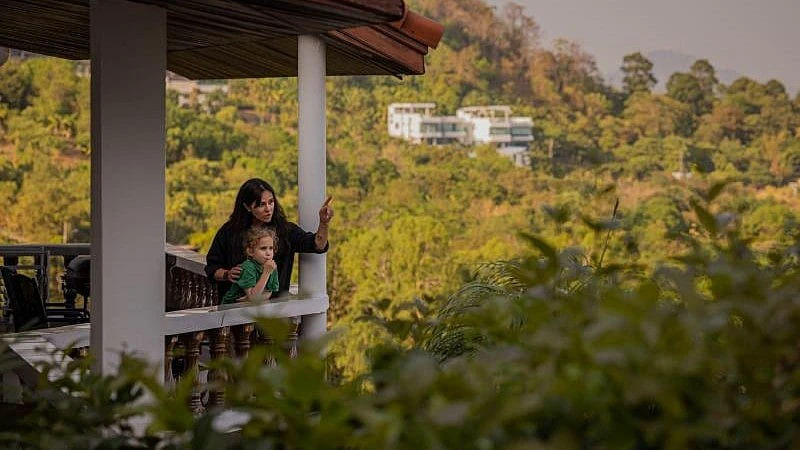
Phuket, Thailand: As she awaited her daughter’s pick-up from school in the tropical heat, Ekaterina Mittsel detailed her 6-year-old’s weekly activities. Mondays are dedicated to choir, gymnastics takes place on Tuesdays and Thursdays, and Russian lessons are reserved for Wednesdays and Saturdays, reflecting the family’s ties to their homeland. The Mittsels are part of a significant wave of Russians who left their country following the 2022 invasion of Ukraine, joining an estimated 30,000 Russian expatriates on the resort island of Phuket. Many of these individuals perceive Phuket as a more tranquil alternative to Bali, Indonesia, a more affordable option than Dubai, UAE, and a more hospitable environment compared to Europe. “We joke that we meet our friends here more often than we did in Moscow,” remarked Mittsel, 36, during an interview at their hillside bungalow overlooking Phuket’s southern coast.
The presence of Russian culture is evident throughout the island, which had already been a favored destination for Russians prior to the conflict. Local Russian saunas remain popular despite the warm climate, while Russian grocery stores offer familiar ingredients. Additionally, daily flights to Phuket are operated by Aeroflot, the Russian state airline. Beachfront eateries serve traditional dishes like cold borscht, and some Russian performers have included the island in their international tours.
However, the expansion of the Russian community in Phuket has also led to some local discontent regarding property accumulation and business ventures, with critics alleging exploitation of the visa system for illegal work. The Thai Foreign Ministry has refrained from addressing specific inquiries related to visa fraud allegations on the island. This growing resentment contributes to an atmosphere of transience among the Russian population, with many, including the Mittsels who hold residence visas, not viewing Phuket as a permanent home. Those on short-term visas are particularly vulnerable to a recent government crackdown on tourist visa regulations.
As of Tuesday, the Thai government has reduced the tourist visa exemption period from 60 days to 30 days, a change that could impact around 15,000 Russians living in Phuket without long-term visas, including young men seeking to avoid conscription. Evgenii, a 39-year-old engineer who requested anonymity due to safety concerns, left Russia in 2022 and traveled across Europe before arriving in Phuket. After working at a real estate agency for six months, he was compelled to quit in order to temporarily leave the country to renew his visa exemption. “I’m good at it,” he stated of his real estate experience, “but I’m always thinking about hopping the border.”
Many young Russians, who remain on the island, attend Orthodox church services on Sundays, where they enjoy communal meals afterwards. Some are pursuing training at local Muay Thai gyms under a 90-day visa available for amateur fighters. As their visa exemptions come to an end, numerous Russians opt to pay $150 for transportation across the border to reset their stay duration, a significant expense for those without stable income. Evgenii expressed plans to visit Vietnam to explore his options for continuing his stay in Thailand, stating, “I’ll either return to Phuket with a visa, or pick up my things and move on.”
Thaneth Tantipiriyakit, head of a provincial tourism association in Phuket, noted that complaints regarding the visa-free policy have been voiced by local residents. “Whenever there’s a foreigner behaving badly, they blame the free visa,” he commented, pointing out that Russians often become the focal point of resentment due to their status as the largest tourist demographic on the island. Similar sentiments have surfaced in Bali, once a welcoming destination for Russian and Ukrainian refugees.
Local residents in Phuket also attribute rising property costs to the influx of Russian buyers, which have made housing less affordable for many Thais. The area known as Bang Tao, the hub of Russian society on the island, has been dubbed ‘Thai Rublyovka,’ referencing Moscow’s elite neighborhood. This region, which was largely undeveloped four years ago, now features resorts, commercial areas, gated communities, and luxury condominiums. According to Thailand’s Real Estate Information Center, Russian buyers represented over half of property sales in Phuket during the initial year of the Ukraine war, contributing to at least a 20% increase in land prices.
Maksim Shatilov, a St. Petersburg native who operates a real estate agency catering to Russian families in Phuket, has witnessed significant growth in his business since the onset of the war. “After the war started, there weren’t many places where you could feel free to be a Russian,” he shared. A recent evening at Come Leo Come, a Russian-themed supper club in Bang Tao owned by a Ukrainian, showcased the affluence of Russian patrons arriving in luxury vehicles while women adhered to a high-heel dress code. The venue, adorned with dim lighting and plush furnishings, features Russian-speaking staff serving premium beverages and gourmet dishes, accompanied by live entertainment.
Despite his success in Phuket, Shatilov, 31, does not view it as a permanent residence, as he and his wife, Alona Myronenko, cannot return to Russia due to her Ukrainian citizenship. “Now the place I really want to travel to is Moscow,” he confessed, “but I don’t feel safe.”
Mittsel echoed similar sentiments about the longing for home. The family departed Russia in 2022 when her husband, a software engineer for an American tech firm, faced payment issues due to U.S. sanctions affecting numerous Russian banks. After settling in Phuket, they were joined by fellow Russian families seeking stability for their children. Each year, the Mittsels contemplate returning to Russia rather than renewing their visas. While they visit their parents during summer breaks, their daughter yearns to experience ice skating and snow. Last year, Mittsel took her to a winter carnival in Bangkok, where they enjoyed artificial snow. Ultimately, they have chosen to remain in Phuket, concerned about their daughter’s adjustment to Russian educational systems.
Mittsel expressed her nostalgia for Moscow’s cultural offerings, such as opera and ballet, but noted that the nightlife scene is not something she misses. Consequently, she and her husband seldom venture from their home at the island’s southern peak to the upscale clubs in Bang Tao. “I don’t have those kinds of outfits,” she explained. “I left them in Russia, like, on purpose.”
Source: Dailyhunt